
During a recent holiday I took some time to do a deeper review of the teaching methods of Eric Mazur. If you are unfamiliar with his ideas and have a bit of time, I strongly recommend watching this video:
My colleagues and I have already been using some of his methods, in particular we have been tinkering with the many different ways that group testing can be used in the classroom. However, after a recent assessment in our waves unit I realized that students were relying heavily on the lecture slides I provided but they were not engaging with other resources like the videos or class textbook.
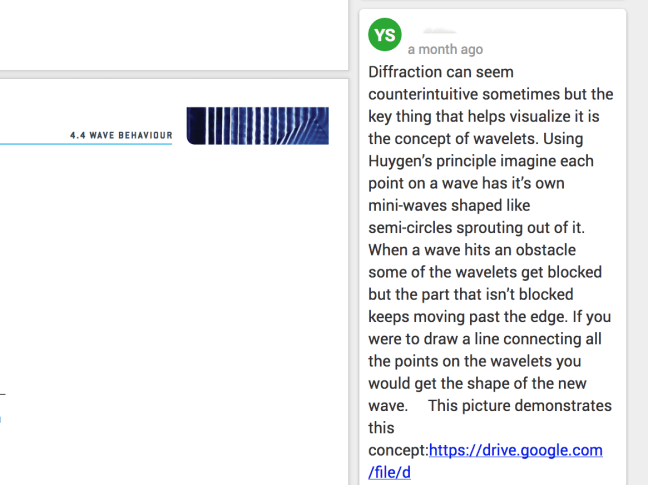
In Eric Mazur’s introductory physics class, one of the learning activities is to complete annotations in the digital textbook before attending the class. I decided that I would also try this with the IB physics students, using a pdf version of our class textbook. I found the website Kami was the easiest one to use for this task and allowed the students to work on the document in groups. The digital dialogue between group members has been one of the most beneficial components of the activity.
The students are engaging more with the material and are doing their best to make connections between current and previous units. Some students have even taken to posting links to other resources in the annotations, finding useful videos or animations to help their group members understand better.
How to score the annotations has been one of the bigger challenges because the grading system of our school is percentage based. I decided to go with the following rubric and this is the sheet that is shared with the students:
Recent assessments clearly show that students have more knowledge of the topic. Their understanding of definitions, diagrams and concepts is greater, so I think this activity has really helped set a foundation for the students to explore the physics. However, there is still a lot of work to be done in getting the students to apply and transfer this knowledge, which is what I’ll be working on going forward.
 The Physics Boss